
How Do Insulated Cooler Bags Help Maintain Food Temperature?
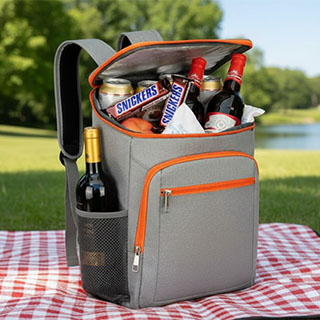
Food temperature shifts fast during a daily commute. It also changes during a picnic, an outdoor event, or a long road trip. Insulated cooler bags slow down this rapid shift. They do this by blocking heat transfer between the stored contents and the outside environment. The actual performance of these bags relies on the specific insulation system. Furthermore, the closure design, the chosen cold source, the packing method, and the daily usage conditions play major roles.
Insulated Bags Slow Heat Transfer
An insulated bag never creates its own cold air. Instead, it builds a protective barrier. This barrier slows down the natural movement of heat. Heat always travels from a warmer spot to a cooler zone. You might place chilled food inside a bag. When you do, heat from the outside air naturally flows toward those colder items. Heat from nearby warm surfaces does the exact same thing.
Heat enters the storage space through three primary paths. First, conduction happens directly through the bag walls. Second, convection occurs due to the regular movement of air. Third, radiation comes from direct sunlight or nearby warm surfaces. A properly built insulated cooler blocks all three of these heat paths. It achieves this goal by combining thick foam, a bright reflective lining, and a very secure closure.
Closed-cell foam successfully cuts down conduction. It traps still air inside thousands of tiny cells. This trapped air cannot move around freely. Therefore, heat travels through the bag walls at a much slower pace. A shiny reflective lining helps drop radiant heat gain. At the same time, a tightly fitted zipper limits the unwanted exchange of warm and cool air. A snug lid does the exact same job.
This thermal process functions well in both directions. A thermal bag can easily slow down heat gain around chilled groceries. It can also stop rapid heat loss from freshly cooked, warm meals. However, you must carry hot and cold items in completely separate compartments. Placing them together in one space forces their temperatures to shift toward each other.
The Complete Bag Structure Determines Performance
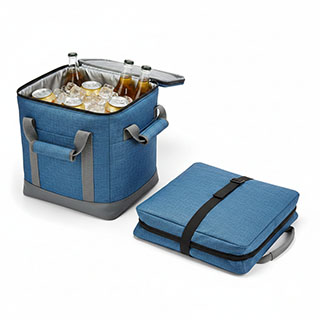
Most cooler bags contain three functional layers. The outer shell provides strength and surface protection. The middle foam layer supplies most of the thermal resistance. The inner lining supports heat reflection, cleaning, and moisture control.
| Componente | Common materials | Main function |
| Outer shell | Polyester, nylon or Oxford fabric | Resists abrasion and light moisture |
| Insulation core | PE, XPE or EVA foam | Slows conductive heat transfer |
| Inner lining | Aluminum PET, PEVA or similar film | Supports heat reflection and cleaning |
| Closure | Zipper, flap or roll top | Limits air exchange |
| Base panel | EVA board or rigid insert | Holds the bag shape under load |
PE, XPE, and EVA are widely used insulation materials because their closed-cell structures resist heat flow without making the bag excessively heavy. Camytonc supports foam thicknesses of approximately 8–15 mm for different cooler bag structures. The appropriate thickness depends on the required holding time, bag size, load, and carrying method.
Thickness alone does not guarantee better performance. Foam density, cell consistency, moisture resistance, and compression recovery also matter. A thick foam that collapses under a heavy load may lose part of its insulating value. A stable foam maintains its shape and leaves fewer weak areas in the finished bag with insulation.
The inner lining also deserves attention. Aluminum-coated materials can reflect part of the radiant heat reaching the bag interior, while PEVA-type linings provide a flexible and wipe-clean surface. Neither material works effectively by itself. The lining, foam, seams, and closure must operate as one system.
Seams and Closures Can Become Heat-Leakage Points
A large zipper opening gives users easy access, but it also allows more warm air to enter. Each time the bag opens, some of the cool air inside is replaced by warmer outside air. A properly fitted zipper and sufficient lid overlap help reduce this exchange.
Seams, corners, handles, and base panels can also interrupt the insulation layer. If the foam becomes too thin around these points, heat may pass through them faster than through the main panels. Consistent cutting and assembly are therefore essential when manufacturing an insulated bag for food.
Water resistance is related to, but different from, thermal insulation. A coated outer fabric may resist rain without preventing leakage from melted ice inside. When a design may hold loose ice or wet containers, the inner lining and seam construction need separate leakage checks.
Operating Conditions Affect Holding Time
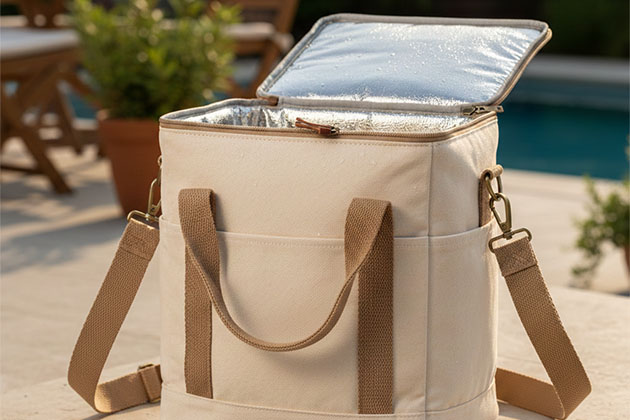
No cooler bag has one guaranteed holding time under every condition. The same design can perform differently in an air-conditioned room, on a shaded picnic table, or inside a parked vehicle.
| Operating factor | Supports longer retention | Reduces retention |
| Starting temperature | Pre-chilled food | Room-temperature food |
| Bag fill level | Full with limited air space | Partly filled |
| Cold-pack position | Around the entire load | Only at the bottom |
| Location | Shade or cool interior | Direct sun or hot vehicle |
| Opening frequency | Infrequent and brief | Frequent or prolonged |
| Closure | Fully closed | Partly open or misaligned |
Starting temperature has an immediate effect. A cooling bag for food is more effective when the food, drinks, and cold packs are already chilled. Placing warm items inside uses up the available cooling capacity much faster.
Fill level also matters. A full bag generally stays cool longer because it contains less empty space filled with warm air. If the food does not fill the compartment, additional gel packs or frozen water bottles can occupy the unused space.
Cold packs should be positioned above, below, and beside the contents when possible. Placing one cold source only at the bottom may create an uneven temperature distribution, especially in a tall bag. Drinks can also be placed in a separate insulated bag because beverage storage is usually opened more frequently.
Matching the Design to the Application
Daily lunch thermal bags need compact dimensions, moderate insulation, low weight, and a lining that is easy to clean. Picnic and travel models often require greater capacity, thicker insulation, reinforced handles, and a stable base.
Outdoor designs may need coated polyester, nylon, or Oxford fabric to handle moisture and repeated use. Internal dividers can keep containers upright, while a separate insulated compartment reduces the need to open the main food area.
Camytonc provides custom cooler bag structures for commuting, picnics, travel, camping, events, and promotional programs. Our customization options include PE, XPE, or EVA insulation, different outer fabrics, internal layouts, carrying systems, colors, logos, and packaging. The minimum order quantity for custom production is 500 pieces, while stock customization can normally be completed within 3–7 days.
Before confirming a design, buyers should specify the bag capacity, food type, expected transport time, ambient conditions, cold-pack arrangement, carrying load, and cleaning requirements. A finished sample should then be tested with a realistic payload rather than evaluated only by foam thickness or appearance.
If you are developing a custom cooler range, send us your dimensions, target capacity, application, quantity, and logo file. You can contact Camytonc for an online quotation or review our custom cooler bag options before requesting a sample.
Perguntas frequentes
How long can insulated cooler bags keep food cold?
Holding time depends on the foam structure, starting temperature, ambient temperature, cold-pack quantity, fill level, and opening frequency. Testing the finished bag under defined conditions provides the most reliable answer.
Do cooler bags need ice packs?
Yes, when chilled or perishable food must remain cold. The insulation slows heat transfer, but ice packs or frozen bottles provide the cooling capacity needed to control the internal temperature.
Can a thermal bag keep food warm?
Yes. Insulation also slows heat loss from warm food. Warm meals should be sealed properly and carried separately from chilled food to avoid unwanted temperature transfer.
Which insulation material is suitable for a cooler bag?
PE offers a practical balance of weight and cost, XPE provides improved moisture resistance, and EVA offers flexibility and compression recovery. The correct choice depends on the structure and intended use.
What should buyers check in a cooler bag sample?
Buyers should examine insulation continuity, closure fit, lining seams, leakage, usable capacity, handle strength, odor, cleaning access, and temperature retention under realistic loading conditions.